Security Architect Jobs

609 jobs found — updated daily

Application Security Architect

OceaneeringHouston, TX
Hybrid

About The Position

The Application Security Architect is responsible for building and operationalizing Oceaneering’s enterprise application security program, embedding security into the software development lifecycle (SDLC), CI/CD pipelines, and developer ecosystem. Role provides the opportunity to work in a hybrid environment, working both virtually and in the Houston office when required.

Requirements

  • Bachelor’s degree in Information Technology, Cybersecurity, Computer Science, Engineering, or related field, or equivalent experience.
  • Minimum 3 years of experience supporting security monitoring, SIEM, or security engineering platforms.
  • Minimum 1 years’ experience administering Splunk Enterprise.
  • Minimum 1 years’ experience supporting Cribl or similar log management technologies.
  • Minimum 1 years’ experience with Syslog architecture and log ingestion technologies.
  • Minimum 1 years’ experience supporting Managed Detection and Response (MDR) services or Security Operations Centers.
  • Minimum 1 years’ experience working with Windows, Linux, network, and cloud log sources.
  • Familiarity with Operational Technology (OT) and Industrial Control System (ICS) environments.

Nice To Haves

  • Splunk Certified Administrator or Splunk Certified Architect certification.
  • Experience with industrial networking and OT/ICS environments.
  • Experience integrating enterprise logging platforms with MDR providers.
  • Knowledge of NIST Cybersecurity Framework, IEC 62443, or ISA/IEC industrial security standards.
  • Experience with scripting and automation using PowerShell, Python, or similar tools.
  • Familiarity with Microsoft Azure and cloud security monitoring.

Responsibilities

  • Define and govern application security requirements, controls, and assurance activities embedded within that model
  • Partner with SCOE to ensure security is integrated without duplicating ownership of engineering platforms, tooling, or development standards
  • Partner with Engineering, the Software Center of Excellence (SCOE), and Cybersecurity leadership to reduce software supply chain risk, implement DevSecOps practices, and enforce secure development standards aligned to Zero Trust principles
  • Establish and lead an enterprise Application Security (AppSec) governance framework, including Secure SDLC and vulnerability management policies
  • Drive adoption and enforcement of secure coding standards, security testing requirements, and remediation SLAs across all application teams
  • Build a risk-based AppSec roadmap aligned to business criticality, “crown jewel” applications, and regulatory requirements
  • Serve as the central authority for secure software supply chain controls and application risk posture.
  • Design and implement a secure developer program addressing: Developer workstations vs business PCs, Removal of excessive local admin privileges, Elimination of unmanaged builds and compilers
  • Lead transformation to secure developer environments, including: Virtualized or hybrid development models, Centralized build infrastructure, Controlled developer access aligned with Zero Trust
  • Reduce risk associated with: Local code storage, Unvetted open-source dependencies, Developer endpoint compromise
  • Architect and implement a secure CI/CD pipeline with embedded controls: SAST, SCA, DAST integration, Secrets scanning, Artifact integrity and provenance validation, Pipeline enforcement (GitHub → CI → Artifact Repository → Test Environments)
  • Ensure no production artifacts bypass secure pipelines and all builds are traceable and verified.
  • Partner with SCOE to standardize DevSecOps tooling and pipeline templates enterprise-wide
  • Establish enterprise-wide application testing program, including: Static (SAST), Dynamic (DAST), and Software Composition Analysis (SCA), Manual and automated penetration testing for critical applications
  • Expand testing beyond web applications into embedded, ICS, and custom software platforms.
  • Build structured pen testing program for crown jewel applications, including third-party partnerships and remediation tracking.
  • Ensure security validation is embedded in CI/CD gates before production deployment .
  • Lead implementation of threat modeling capabilities for critical applications to identify design flaws early in SDLC.
  • Define and enforce secure-by-design principles across engineering teams.
  • Collaborate with architects and engineering to integrate Zero Trust architecture, segmentation, and secure design patterns.
  • Implement centralized tooling to: Aggregate SAST, SCA, DAST, and pen test findings, Provide a single pane of glass for application risk, Drive prioritization and remediation of vulnerabilities based on business risk and technical severity.
  • Establish KPIs such as: Mean time to remediate (MTTR), % of critical vulnerabilities fixed before release, Coverage of testing across applications
  • Build and lead a role-based application security training program for developers, architects, and QA
  • Provide: Secure coding guidance (language-specific), Secure development playbooks and reference architectures
  • Partner with SCOE to embed security practices into daily developer workflows and pipelines.
  • Expand the SCOE charter to include DevSecOps governance and enforcement.
  • Drive: Adoption of enterprise CI/CD standards, Secure pipeline templates, Standardized DevSecOps toolchain
  • Improve visibility and enforcement of security policies across all development teams.

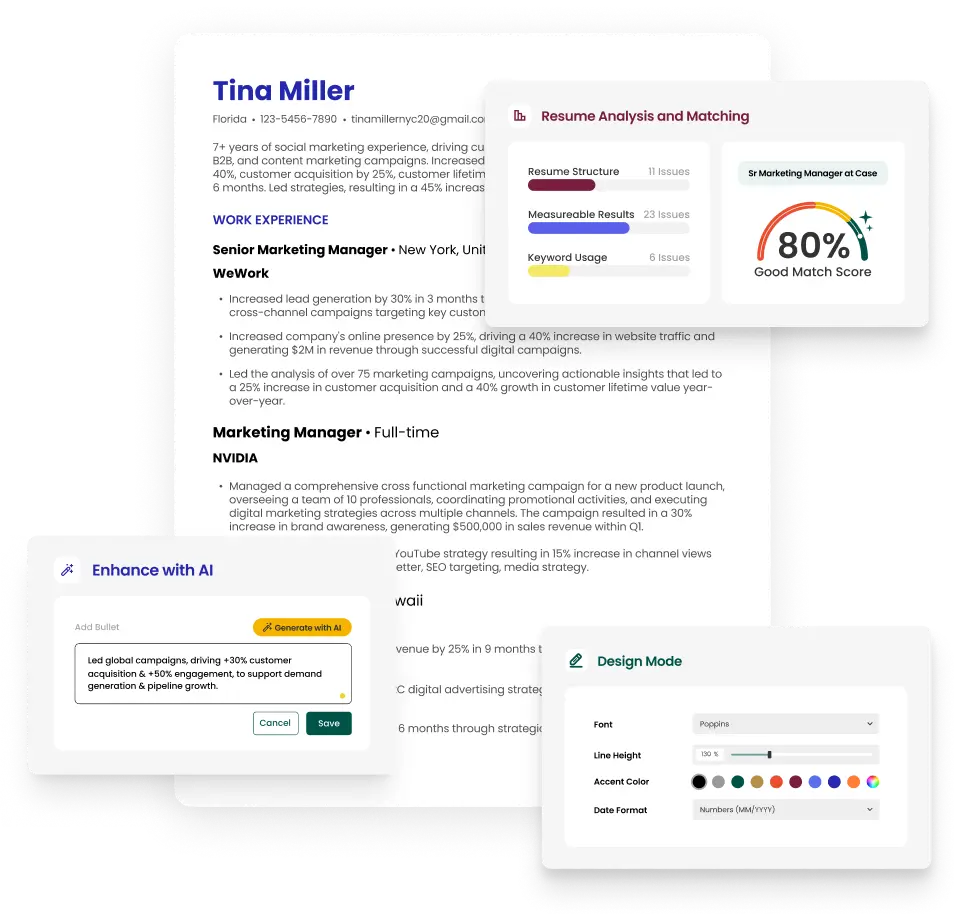
Build a Resume for Security Architect

The resume builder that gets results.

  • Get clear feedback so you look as qualified as you are
  • Align your resume with the job to get further in the process, faster
  • Take the guesswork out of resume writing

Explore Related Job Searches

© 2026 Teal Labs, Inc
Privacy PolicyTerms of Service