
2,000+ Free Resume Examples and Samples for Your 2026 Job Search
Browse 2,000 resume examples by job, industry, format, and experience level that you can edit on your phone, laptop, or tablet. Every sample is created and approved by our team of certified professional recruiters & resume writers that get you a job 58% faster. Start with the example of your choice and customize it in our resume builder to make it your own.
Build Your Resume for Free











Popular Resume Examples
Administrative
Make your administrative resume stand out by putting forward how you’ve streamlined operations, supported executives, or kept offices running smoothly. Highlight and quantify your achievements like reducing scheduling conflicts, improving systems, or boosting team efficiency. Popular metrics to help you quantify your impact are things like hours saved per week or number of projects coordinated. These examples will guide you in framing skills like organization, communication, and multitasking so hiring managers see the real impact you bring to any admin role.
Content
Show off your ability to create, edit, and strategize with impact by highlighting projects that boosted engagement, increased traffic, or improved brand voice. Whether you’re a writer, editor, or content strategist, emphasize both your creativity and your results but don't forget to quantify them with real metrics! Think pageviews, conversation rates, organic traffic, or audience growth. These examples will guide you in presenting a resume that reflects not just your skills, but also your ability to drive measurable outcomes from great content.
Customer Service
Highlight how you’ve turned customer challenges into positive outcomes whether that was by resolving issues quickly, improving NPS scores, or retained revenue. Showcase your skills in problem-solving with measurable results, using metrics like reduced response times or higher customer retention. These examples help reps, agents, and managers frame their impact so employers see your real value that was behind every interaction.
Data & Analytics
Show how you turned numbers into insights that helped drive smarter decisions. Be sure to highlight your achievements like building dashboards that saved time, or uncovered trends that shaped strategy, or improved models that boosted performance. Whether you’re an analyst, data scientist, or data engineer, these examples help you frame your technical skills in terms of measurable business impact so hiring managers see the story behind the data.
Design & UX
Make yourself stand out by talking about how your designs solved problems, improved user experiences, or brought a brand’s vision to life. Go beyond listing tools like Figma or InDesign and highlight the process, collaboration, and outcomes behind your work, like increasing engagement, auditing processes, simplifying workflows, or driving conversions. These examples help UX specialists, graphic designers, product designers, and other creatives present your portfolios in resume form, making your impact clear.
Dev & Engineering
Show off your ability to code, build, and solve problems by highlighting projects that improved performance, streamlined systems, or launched new features. Whether you’re a software developer, engineer, or IT professional, you must report on both technical skills and measurable results. Think faster load times, reduced downtime, or successful product launches. These examples will guide you in framing complex work clearly while proving the real impact of your work.
Education
Highlight your ability to teach, lead, and inspire by highlighting achievements that improved student outcomes, streamlined programs, or built school communities. Whether you’re a teacher, administrator, or education professional, emphasize both your skills in measurable results. For example: higher test scores, increased graduation rates, improved engagement, or successful curriculum rollouts. These examples will guide you in presenting a resume that demonstrates not just your credentials, but the tangible impact of your work.
Finance
Strong finance resumes balance detail with large-scale strategic thinking. When writing your resume be sure to highlight how you’ve improved forecasting, optimized budgets, or uncovered opportunities that drove revenue. Whether you’re an accountant, analyst, or finance leader, focus on both technical accuracy and measurable business outcomes. Think cleaner audits, reduced costs, revenue growth, or stronger compliance frameworks. These examples will help you frame your experience in a way that shows financial expertise and bottom-line impact.
Human Resources
The best HR resumes highlight how you lead teams, shape culture, and support business goals beyond day-to-day policies. These examples will guide managers, recruiters, and specialists in showcasing both people skills and measurable impact. The best metrics include lower turnover, faster hiring, or improved employee engagement.
Information Technology
Make yourself stand out by showing how your IT expertise solved problems, secured systems, or kept critical operations running. Go beyond listing tools or certifications and highlight the scope, collaboration, and outcomes behind your work. For example: Reducing downtime, strengthening cybersecurity, cutting costs, or scaling infrastructure. These examples help sysadmins, network engineers, and IT professionals frame their technical achievements in a way that makes real impact clear.
Legal
Writing a resume for jobs like these is complex work that needs clarity and precision. Be sure to go beyond listing cases or contracts and highlight outcomes like reducing risk, improving compliance, or supporting successful trial strategies. These examples help attorneys, paralegals, and legal specialists frame your experience in a way that’s simple, credible, and results-driven.
Marketing
Strong marketing resumes don’t just list campaigns, they prove how your work moved the needle. Employers want to see creativity backed by results, whether that’s higher conversion rates, bigger audiences, or stronger brand loyalty. Use these examples to learn how to present metrics, strategy, and storytelling in a way that makes your experience both credible and compelling.
Operations
Effective operations resumes focus on how you make organizations run better every day. Instead of just listing your responsibilities, show the results of them: how much you cut costs, sped up delivery times, or improved cross-team efficiency. These examples will help COOs, operations managers, and logistics leaders translate your behind-the-scenes work into clear, measurable impact.

Product
A strong product resume makes it clear how you influence outcomes across teams and markets. Go beyond feature lists and demonstrate the value you delivered, whether that’s launching products on time, increasing product adoption, or shaping revenue-driven roadmaps. These examples give product managers and coordinators a framework for turning responsibilities into stories of measurable business impact.
Project Management
Employers look for project managers who can align teams, manage complexity, and deliver results. Your resume should demonstrate all of the above and how you kept initiatives on track. That could mean metrics like hitting deadlines, controlling scope, or coordinating with stakeholders. These examples show you how to turn projects into proof points of leadership, organization, and impact.
Sales
Great sales resumes don’t just list quotas, they prove how you exceeded them. Show how you built pipelines, closed deals, and grew accounts with numbers that speak for themselves: revenue gains, client retention, or record-breaking conversions. These examples help sales reps, executives, and managers turn achievements into a compelling story of growth and impact.
Other
For unique professions and emerging fields, our tailored resume examples help you showcase your specialized skills and experiences, ensuring you stand out in any industry.
Proven Resume Templates that Land Interviews
Over 100 pre-designed templates created with best
practices to help you build a faster, more impactful resume.
Don’t just take our word for it

Love the platform
100% game changer. Instead of reworking my resume over and over, it's helpful to have clear direction on which tweaks to make and how to tailor it for the job you are applying for. It brings in metrics and measures how closely your resume matches the job requirements, responsibilities. Love the creators/founders. Super supportive and really friendly!

Its resume builder excels
I would say this is the BEST tool and chrome extension I've used so far. It greatly decreases the amount of time it takes to: 1) track job postings and applications (email wasn't organized, spreadsheets are manual) and 2) tailor resumes. Its resume builder excels at identifying keywords and assessing alignment.

Grow your career
It is by far one of the most beautifully designed, intuitive, and powerful job application tool I have ever come across. If you are a professional looking to maintain your network, job search with purpose/intentionally, and continually grow your career, look no further than Teal.
What to put on your resume
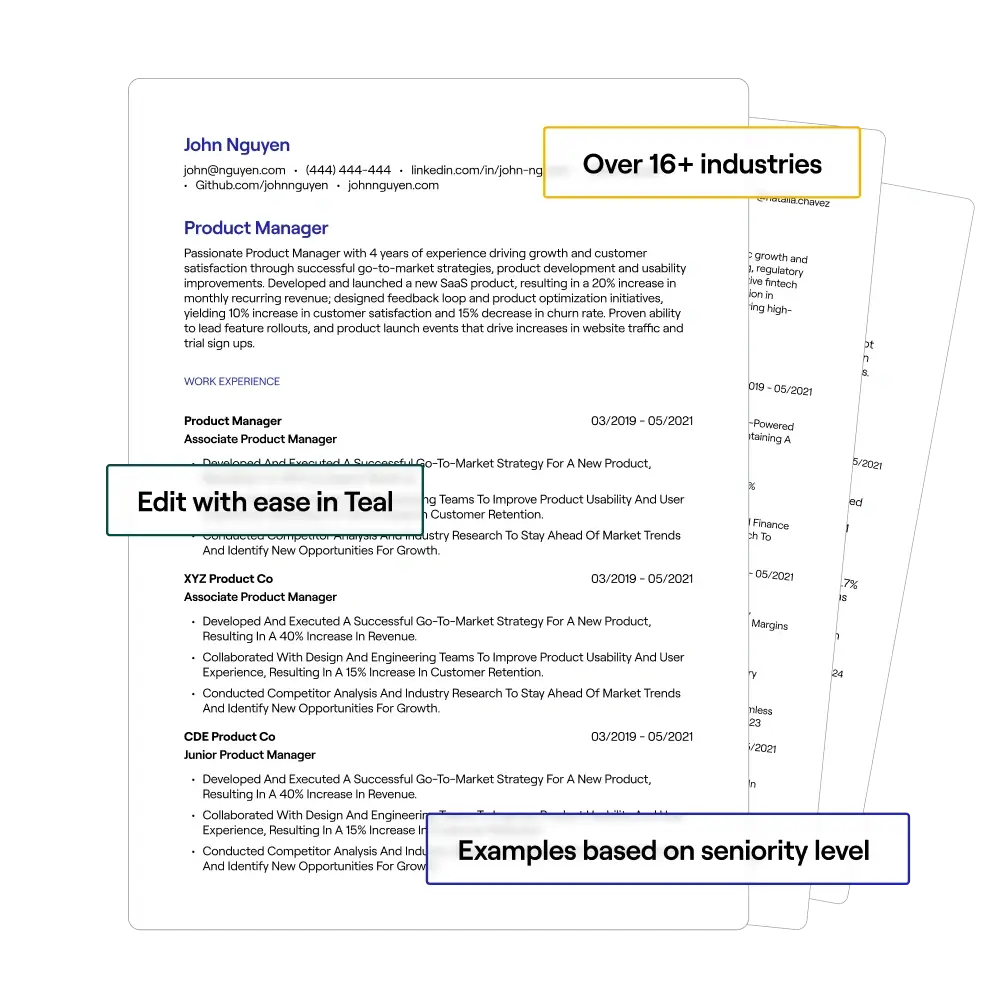
Passionate Product Manager with 4 years of experience driving growth and customer satisfaction through successful go-to-market strategies, product development and usability improvements. Developed and launched a new SaaS product, resulting in a 20% increase in monthly recurring revenue, designed feedback loops and product optimization initiatives yielding 10% increase in customer satisfaction and 15% decrease in churn rate.
Work Experience
- Led the development and launch of a new SaaS product, resulting in a 20% increase in monthly recurring revenue within the first quarter.
- Implemented a customer feedback loop, resulting in a 10% increase in customer satisfaction ratings and a 15% decrease in churn rate.
- Developed and executed a successful go-to-market strategy, resulting in a 50% increase in website traffic and a 30% increase in sign-ups.
- Developed and executed a successful go-to-market strategy for a new product, resulting in a 40% increase in revenue.
- Collaborated with design and engineering teams to improve product usability and user experience, resulting in a 15% increase in customer retention.
- Conducted competitor analysis and industry research to stay ahead of market trends and identify new opportunities for growth.
- Assisted senior product managers in conducting market research, creating product roadmaps, and tracking product performance metrics.
- Collaborated with cross-functional teams to gather customer feedback and implement changes to improve product features.
- Assisted in the planning and execution of product launch events and marketing campaigns.
Education
- Product Management
- Business
Skills And Competencies
- Project Management
- Strategic Planning
- Product Launch and Promotion
- Market Research and Analysis
- Product Roadmapping
- Competitor Analysis
- User Experience Design
- User Interface Design
- Data Analysis
- Business Analysis
- Customer Feedback Management
- Cross-Functional Team Management
- Product Performance Tracking
- Product Usability Optimization
- Agile Software Development
- Scrum Methodology
- Kanban Methodology
Contact Information
The goal of your contact information is to make it easy for an employer or hiring manager to learn more about you and be able to easily reach out if they are interested in your application.
Target Title
It's crucial to include a Target Title on your resume as a way to help recruiters or hiring manager identify you as a strong candidate. All Job Titles on your resume can be picked up by the Applicant Tracking System (ATS) and help show that you are a great fit for the specific role you are applying to.
Professional Summary
The Professional Summary is a key place for you to craft a compelling narrative of your relevant professional experience, skills, and accomplishments. Think of your summary as a teaser for the employer to read the rest of your resume. To maximize impact, aim to reference metrics and numbers where possible to emphasize the results you've delivered in previous roles.
Work Experience
Arguably the most important section on your entire resume, your Work Experience is what employers will ultimately spend the most time reviewing to determine if you're a qualified candidate. Focus on highlighting your most relevant and impactful accomplishments, relative to the specific role you're applying for. Your priority should be to tailor your work experience to align with the responsibilities of the position as much as possible.
Education
Keep your education section clean and relevant by only including the schools / colleges / universities that really matter and relate to your profession and job search goals. Check if the job posting asks for a specific degree and make sure to highlight this in your resume, if applicable.
Skills
The skills section of your resume shows employers you have the abilities required for the role you are applying to. Applicant Tracking Systems (ATS) will leverage the skills in your resume to assess how high of a match score your resume is to the job posting and prioritize higher matching resumes first.
Essential guides for job searching
More Resume Samples by Title
Resume Example FAQs
How do you create a strong resume?
To write a strong resume, focus on clarity, tailoring it to the job description, and highlighting measurable achievements. Use strong action verbs, include relevant keywords for ATS, and keep formatting clean and professional. Make sure your resume is easy to scan, with clear sections for skills, experience, and education.
What mistakes should you avoid on a resume?
Common mistakes include using long paragraphs, typos, outdated information, or an unprofessional design. Avoid vague job duties and instead focus on results and achievements.
How will resume examples help with creating a resume?
Resume examples can help you by showing proven formats, styles, and language that hiring managers and applicant tracking systems (ATS) respond to. They provide inspiration for how to highlight your skills, experience, and accomplishments effectively. Using resume examples as a guide makes it easier to structure your resume and create a polished, job-ready document.
How long should a resume be?
A resume should typically be one page if you have less than 10 years of experience, keeping it concise and focused on relevant achievements. For seasoned professionals with extensive experience, a two-page resume is acceptable to showcase key accomplishments without overwhelming the reader. The goal is clarity and impact.
What makes a good resume example stand out to employers?
A good resume example stands out by being concise, well-structured, and tailored to the job. It highlights measurable achievements, uses action verbs, and demonstrates how past experiences align with the job requirements. Clear formatting and error-free writing are also crucial.
How closely are your resume examples tailored to individual roles?
Our resume examples are meticulously tailored to fit individual job roles, reflecting modern requirements and responsibilities. Each example, from the summary to skills and work experience, is customized to demonstrate the ideal candidate profile, ensuring you have a relevant and effective template for your application.
What advice do you offer for adapting resume examples to my own job search?
We recommend using our resume examples as a foundation for your document, then customizing it by adding your unique experiences, skills, and accomplishments. Tailoring your resume to reflect the job you're applying for, using relevant keywords, and emphasizing your achievements, will make your application more relevant and appealing to potential employers.
Accelerate Your Job Search with the Resume Builder
- Create, optimize, duplicate and manage unlimited resumes for a much faster workflow throughout your search.
- Generate tailored professional summaries, resume bullets, and cover letters to save time and improve quality simultaneously.